


Central Solenoid
2 min read
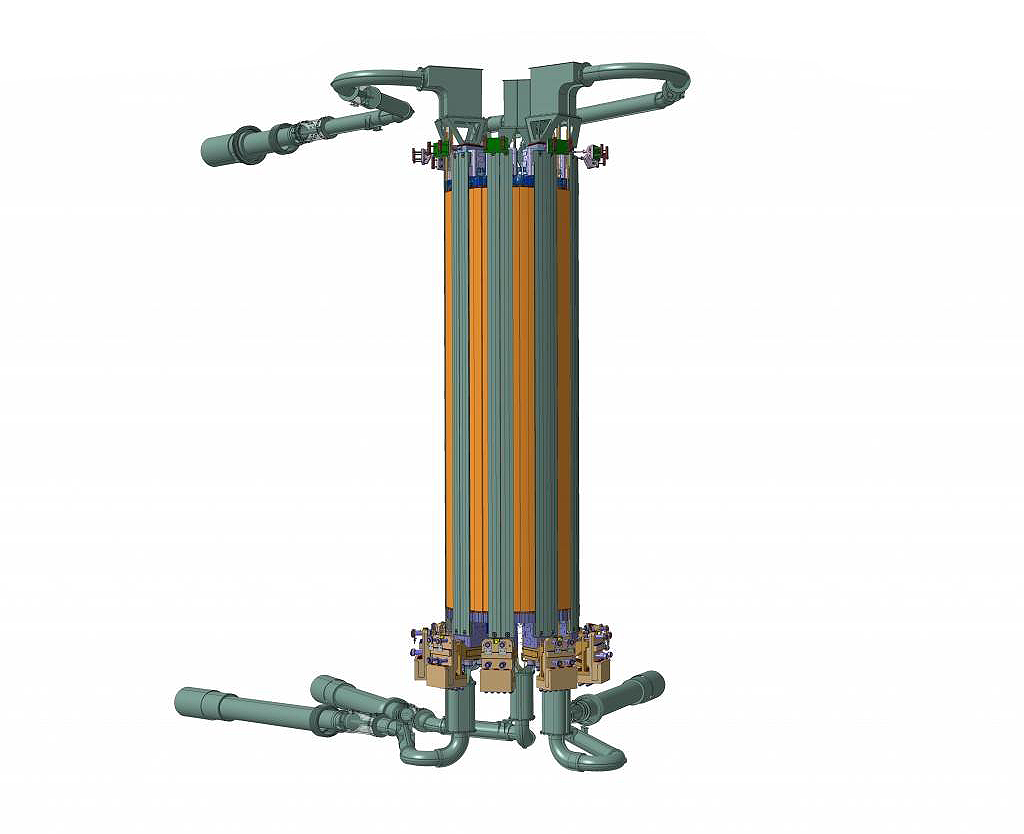
Central solenoid of ITER tokamak.
A transformer is a device that can increase or decrease voltage and current by electromagnetic induction. It consists of primary and secondary windings linked by a changing magnetic flux. In a tokamak, the plasma acts as a single-turn secondary circuit, and a changing current in the central solenoid induces a toroidal electric field that drives the plasma current.
The primary winding is usually located in the centre of the tokamak torus, in the “doughnut hole”, and forms the central solenoid. It may consist of several coil modules stacked together. Because the central solenoid generates very strong magnetic fields, it is subjected to large electromagnetic forces and therefore requires a robust support structure.
The solenoid coils are held in a strong support structure that withstands the electromagnetic forces generated during operation. The large amount of electrical energy needed to change the solenoid current is supplied by powerful pulsed power systems, which may include capacitor banks, flywheel generators and grid-connected power converters.
In ITER, the world’s largest tokamak under construction, the central solenoid consists of six independently powered modules. The coil stack is about 13.5 metres tall and 4.1 metres in diameter, while the complete assembly with its support structure reaches about 18 metres and weighs around 1,000 tonnes. The maximum magnetic field in the centre of the stack will reach 13 tesla.
Spherical Tokamaks
In spherical tokamaks, the central “doughnut hole” is minimised so that the confined plasma has a more spherical shape. Some concepts aim to operate without a central solenoid and therefore investigate non-inductive methods of initiating and sustaining the plasma current, including radio-frequency and microwave techniques. Eliminating the central solenoid could simplify the device and make steady-state operation easier to achieve.

Magnetic field generated by a solenoid.
Online 3D Model
Free Downloads › Online 3D

