


Timeline
4 min read
1985
The idea of an international fusion collaboration was proposed at the Geneva Superpower Summit by Soviet General Secretary Mikhail Gorbachev to US President Ronald Reagan.
1986
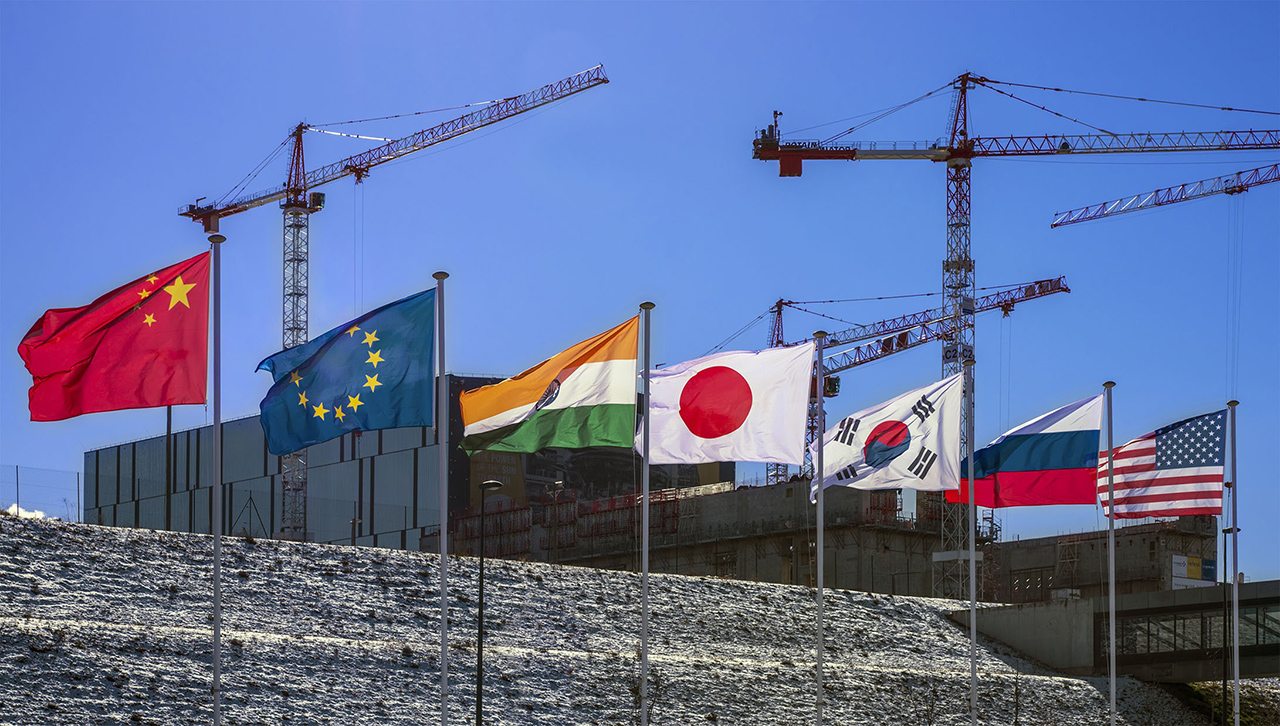
The flags of the seven ITER Members — China, the European Union, India, Japan, the Republic of Korea, Russia and the United States — fly over the ITER construction site.
1988
Conceptual design work on ITER began.
1992
The conceptual design phase was completed, and more detailed engineering design activities followed. Several possible host sites were considered, including locations in the United States, Europe and Japan.
1998
Engineering Design Activities were completed, providing the basis for the final ITER design.
2001
The final ITER design was approved by the participating Members.
2003
The choice of ITER site was narrowed to Cadarache in France and Rokkasho-Mura in Japan. China and the Republic of Korea also joined the ITER project.
2005
After extensive international negotiations, the ITER Members agreed to build the project at Cadarache in southern France. India joined ITER in the same year, bringing the number of Members to seven.
2006
The ITER Agreement was signed in Paris on 21 November 2006 by China, Euratom, India, Japan, the Republic of Korea, the Russian Federation and the United States.
2007
The ITER Organization was formally established on 24 October 2007.
2007–2009
Site preparation, land clearing and levelling were carried out. By 2009, the platform was ready for construction of the scientific buildings and facilities.
2008
Work began on the 104-kilometre ITER Itinerary, a specially modified transport route from the port of Berre-l’Étang to the ITER site for exceptionally large and heavy components.
2008
Manufacturing of major ITER machine components began across the seven ITER Members.
2010–2014
The ground support structure and seismic foundations for the Tokamak Complex were constructed.
2010–2024
Construction of the ITER plant and auxiliary buildings, except the Hot Cell Facility.
2012
ITER became a Basic Nuclear Installation under French law, marking a major nuclear-licensing milestone.
2012
The 257-metre-long Poloidal Field Coils Winding Facility was completed, enabling five of ITER’s giant poloidal field coils to be manufactured on site.
2014–2023
Construction of the Tokamak Complex progressed, with the Assembly Hall becoming available for installation activities in 2017 and access to the Tokamak Pit following in 2018. Civil works for the Tokamak Complex were completed in 2023.
2015
Transport of the largest ITER components to the site began along the specially prepared ITER Itinerary.
2020
The first toroidal field coil was delivered to the ITER site, and machine assembly began.
2020–2033
Assembly Phase I: installation and integration of the core ITER machine and systems required for the Start of Research Operation.
2021
The first major magnet installed in the machine, poloidal field coil PF6, was positioned in the Tokamak Pit.
2022
Welding of the vacuum vessel sectors began.
2024
The ITER Council reviewed the updated project baseline and approved its overall approach.
2033
Cryostat closure is planned, marking completion of the principal machine assembly phase.
2033–2034
Integrated commissioning of the ITER machine and supporting systems is planned.
2034
Start of Research Operation is planned.
2036
ITER is expected to reach full magnetic energy.
2039
Deuterium–tritium operation is expected to begin.

ITER construction site.

