









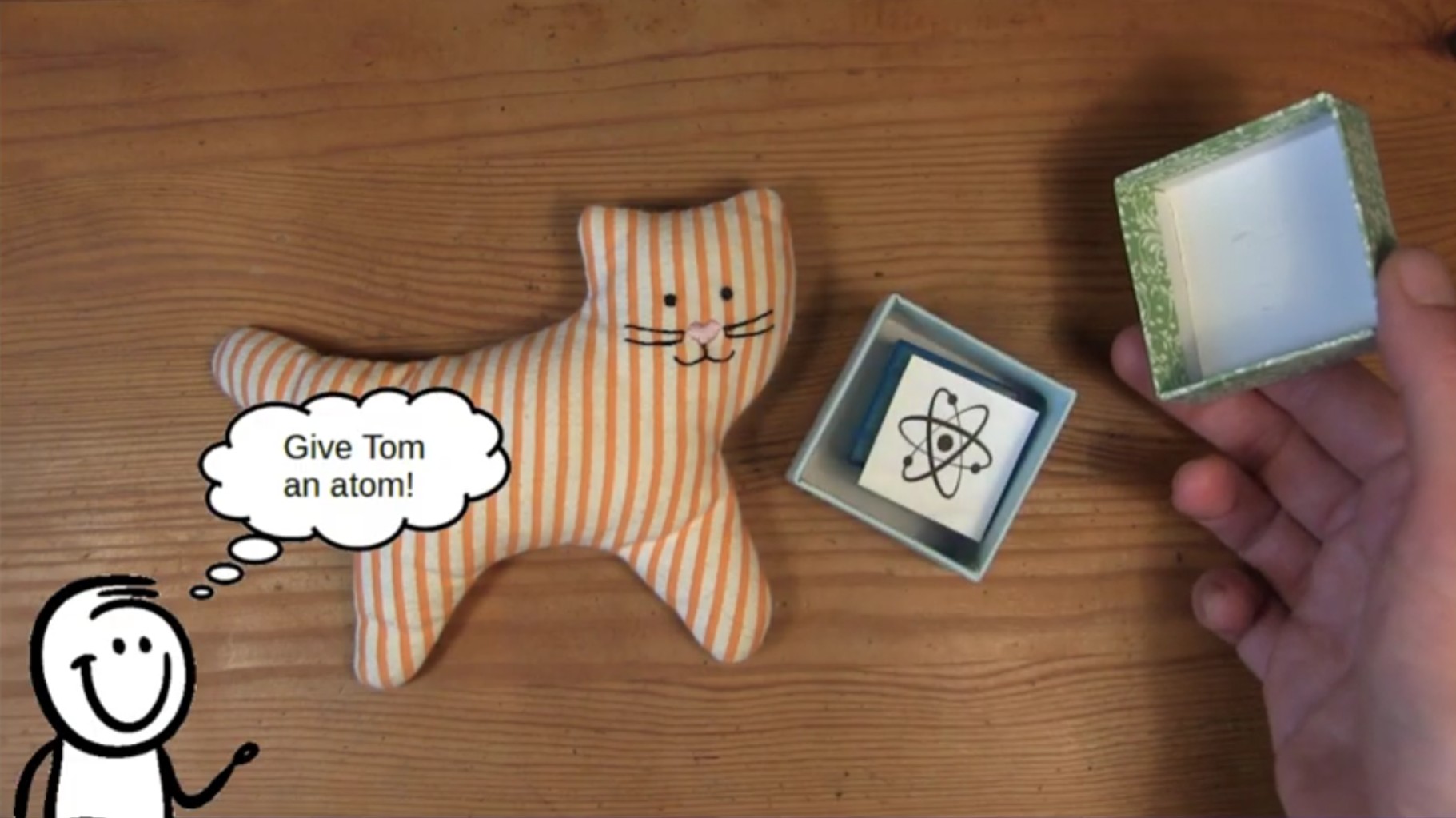
Imagine taking an apple and cutting it in half. Cut that half in half again, and then cut the resulting piece in half again, and so on. How small a piece would you end up with? You might be able to work your way down to a single atom.
Its name means “indivisible”. This concept was introduced some 400 years before our era by the Greek scholar Democritus, who was considering whether matter could be divided indefinitely or not. He came to the conclusion that there must be some small, indivisible particles of matter, and he called them atoms.
Many, many centuries later, people actually discovered and studied atoms, only to find that they are not indivisible. Atoms consist of a nucleus around which electrons orbit, and these are particles that cannot be further divided. Although the word “orbit” is not entirely accurate, electrons are not actually balls resembling planets in orbit, even though we like to depict them that way. They are more like clouds of probability. However, because the world of atoms is completely different from ours, you can continue to imagine electrons as balls for your peace of mind.
They have a negative electric charge and orbit around the atomic nucleus, which contains neutrons and protons. Neutrons are neutral, and protons have a positive electric charge. Compared to the entire atom, the atomic nucleus is extremely small. If the whole atom were the size of a football stadium, the nucleus would be the size of an apple seed placed in the middle.
Neutrons and protons appear to be very stable (and although we often depict them as balls, they almost certainly do not look like balls), but in reality they have an internal structure. They are composed of quarks.
The properties of quarks are so different from the properties of things we know from our macroscopic world that scientists have given them rather bizarre names, dividing them into up, down, strange, charm, bottom, and top quarks. A proton consists of two up quarks and one down quark, while a neutron consists of two down quarks and one up quark. They are held together by gluons, which are elementary particles that bind quarks together inside every atomic nucleus. As far as we know, quarks have no internal structure.
The atom is therefore not indivisible. This basic building block of all matter around us is made up of electrons, quarks, and gluons.
Want to ask something?
Send us an e-mail with the subject “Physics mysteries” to the address:
We can't wait to tackle your interesting questions!

