




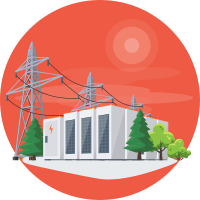
With the rapid development of renewable energy sources and their connection to the transmission system, new requirements for its operation have emerged. For us as consumers, they’re not really new — we expect to have electricity available constantly, at the same “quality”, and just as reliably. Fulfilling this expectation was not easy even before, which is why investments in electrical grids are still being made.
However, nowadays there are rapid changes in consumption (typically in households by using high-power appliances or a home photovoltaic power plant), and especially in production. Because we cannot destroy energy (obtained in power plants), just like any other form of energy, the amount of energy generated in power plants should be equal to the amount of energy consumed. Compared to traditional power plants, where we know when and how much electricity they will supply to the grid, renewable sources are less predictable. This led to the development of so-called smart grids, which detect the state of the transmission system at as many locations as possible within milliseconds and manage it based on this data. A smart grid is essentially a traditional transmission system, expanded with data transmission and control elements that manage the direction of energy flow within the grid as needed. For example, a household consumes electricity, but if it’s sunny, electricity won't flow from the grid to the household but the other way around — from the photovoltaic power plant to the grid.
Thanks to real-time data and the ability to predict network behavior, for example, high-consumption appliances can be easily switched on during times when network production exceeds consumption. At this time, electricity is significantly cheaper.
Data from individual locations within the grid are also important for monitoring its stability and preventing blackouts.
Smart grids are therefore a necessary evolution of the distribution network; without data transmission, the transmission of electricity would still be functional but either fewer renewable sources could be connected to the grid, or electricity supplies would not be stable.
Want to ask something?
Send us an e-mail with the subject “Physics mysteries” to the address:
We can't wait to tackle your interesting questions!

