








Fusion Reactor Concepts for Power Plants
3 min read
The most mature concepts for the first demonstration fusion power plants are based on tokamaks, but other approaches are also being developed, including stellarators, inertial confinement and several alternative magnetic or magneto-inertial concepts. Their technological readiness and remaining challenges differ considerably.
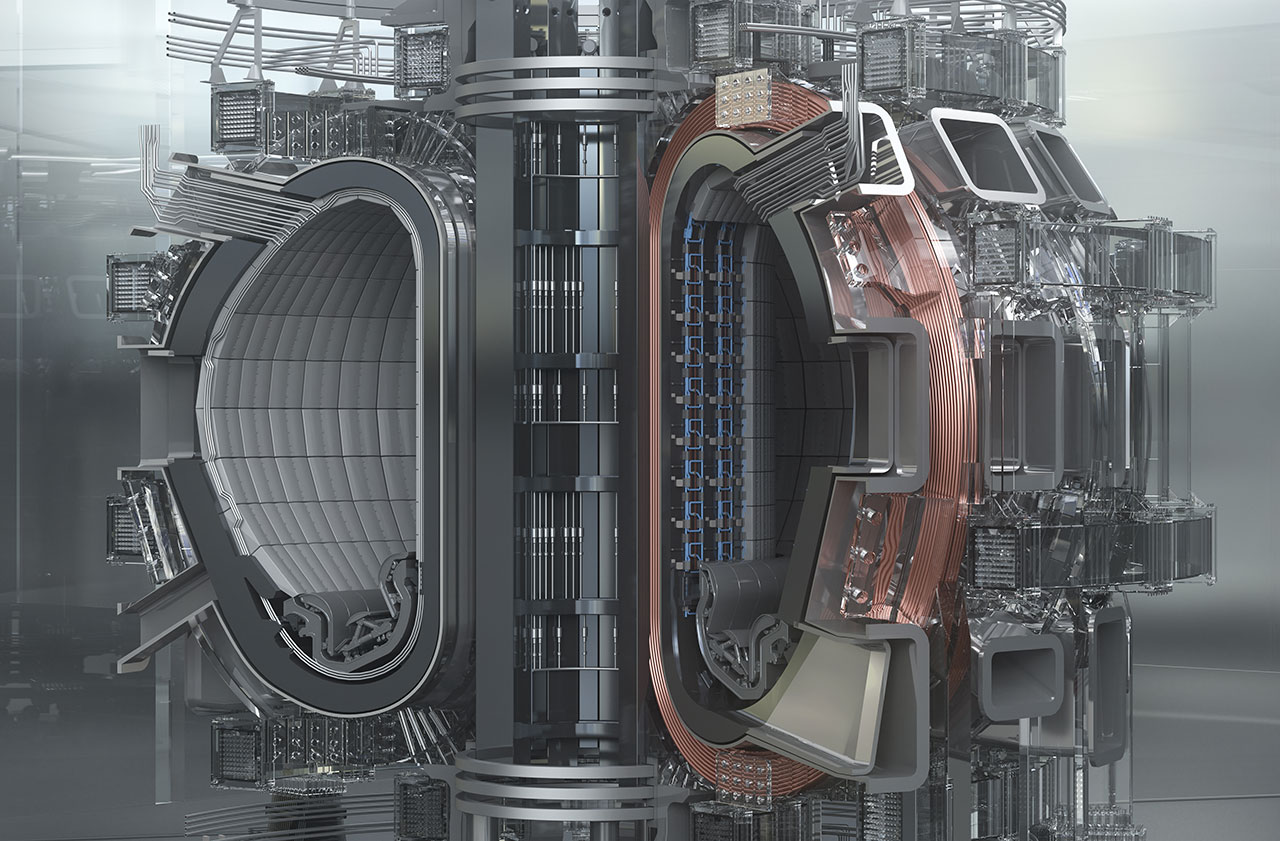
A future fusion power plant could be based on the tokamak principle.
Tokamak
Tokamaks are currently the most mature magnetic-confinement concept for fusion energy. Decades of experiments have established operating regimes with good confinement and developed increasingly effective methods for controlling turbulence, instabilities and plasma exhaust. Tokamaks have produced deuterium–tritium fusion power, although none has yet reached scientific breakeven. Their main advantage is the depth of experimental knowledge and engineering experience already available. However, major challenges remain, including sustained high-performance operation, disruption control, tritium breeding, neutron-resistant materials, remote maintenance and plant availability. Steady-state tokamak operation may be possible using non-inductive current drive and bootstrap current, but this has not yet been demonstrated at power-plant scale.

Laser-driven inertial fusion is another possible route to fusion power.
Stellarator
Stellarators offer an important advantage over tokamaks because their confining magnetic field is generated entirely by external coils, allowing inherently steady-state operation without the need for an inductively driven plasma current. They may also avoid some disruption-related problems characteristic of tokamaks. Their disadvantages are greater geometric and engineering complexity and a smaller experimental database. No stellarator has yet operated with deuterium-tritium fuel, so burning-plasma behaviour remains untested experimentally. Advances in computational optimisation and the performance of devices such as Wendelstein 7-X have nevertheless strengthened the stellarator as a possible long-term power-plant concept.
Inertial Confinement
Inertial confinement fusion is the only approach that has so far achieved laboratory ignition with a fusion yield greater than the laser energy delivered to the target. NIF first achieved this milestone on 5 December 2022 and has since repeated ignition many times. Turning this into a power plant, however, would require major advances in driver efficiency, pulse repetition rate, low-cost target manufacture and injection, chamber clearing, optics protection, tritium breeding and continuous heat removal. Historical power-plant studies such as HYLIFE II explored heavy-ion drivers and flowing liquid blankets, but no such plant is currently under construction.
Alternative Approaches
Several alternative approaches are also being pursued. Magnetised target fusion combines magnetic confinement with rapid mechanical compression of a pre-formed plasma, while field-reversed configurations use compact magnetised plasmas that can be accelerated, merged and compressed. Other concepts include pulsed magnetic systems, compact high-field tokamaks and advanced inertial-fusion schemes. Some are being developed by private companies on aggressive timescales, but none has yet demonstrated the full combination of fusion gain, repetition rate, tritium self-sufficiency, component lifetime and net electricity production required for a commercial power plant.