


How to Measure the Temperature in the Core of the Sun — Plasma Diagnostics
5 min read
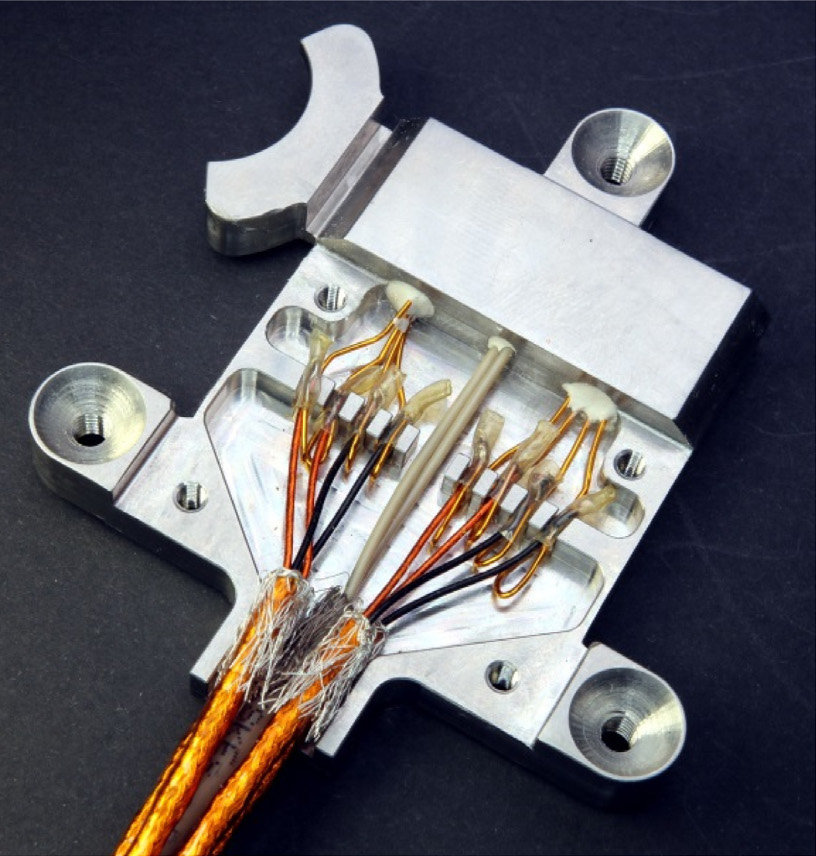
Hall sensor for ITER magnetic diagnostics.
Measuring the properties of matter at extremely high temperatures, such as fusion plasma, is difficult because any measuring device inserted directly into the hot plasma would be rapidly destroyed. To understand and control fusion plasma, however, it is necessary to know as much as possible about its shape and position, temperature, density and composition. In magnetic confinement devices, the plasma current and magnetic-field configuration are also important, as well as whether fusion reactions are occurring and how much fusion power is being produced.
Plasma diagnostics can be either passive or active. Passive diagnostics observe particles or electromagnetic radiation emitted by the plasma, while active diagnostics probe it using microwaves, lasers or particle beams and measure the plasma response. Only a limited number of diagnostics make direct contact with the plasma, usually at its edge and only under suitable conditions; these include various types of probes.
Many diagnostics require high temporal resolution to follow rapid changes in the plasma, while others focus on slower processes. Some provide local measurements, others measure global quantities, and some provide line-integrated data. By combining measurements from multiple diagnostic techniques with computational reconstruction methods, detailed profiles of plasma density, temperature and other parameters, together with their evolution in time, can be obtained.
Here is the list of some important plasma diagnostic methods in more detail:
Magnetic Diagnostics
Magnetic diagnostics are used to measure basic plasma parameters such as plasma current, position, shape and stored energy, and to detect plasma instabilities. Many of them rely on Faraday’s law: changes in magnetic flux induce voltages in surrounding loops or coils. Pick-up coils help determine plasma position and shape, Hall sensors measure local magnetic fields, Rogowski coils measure plasma current, loop-voltage measurements are used to determine the applied toroidal electric field and ohmic input power, and Mirnov coils detect magnetic fluctuations associated with plasma instabilities.
Microwave Diagnostics
Microwave diagnostics operate over a broad frequency range and include both active and passive techniques. In reflectometry, a wave is launched into the plasma and reflected from a layer where the plasma reaches a characteristic cutoff density, providing information about the electron density profile and plasma position. Interferometry measures the phase shift of radiation passing through the plasma and is used to determine line-integrated electron density. Polarimetry provides information about the internal magnetic field and current-density profile. Electron cyclotron emission is a passive diagnostic used primarily to measure the electron temperature profile. Collective Thomson scattering can provide information about the velocity distribution of fast ions, including fusion-born alpha particles. The emission frequency depends mainly on the local magnetic-field strength and therefore corresponds to a particular position in the plasma, while the emission intensity provides information about the electron temperature.
Spectroscopy
Spectroscopy in the visible, ultraviolet and X-ray regions provides information about impurity composition, ion densities, ion temperatures and plasma rotation by analysing the light emitted by the plasma. In many cases, tomographic or other computational reconstruction methods are required to obtain spatial profiles. Bolometers, which are not spectrometers, measure the total radiated power over a broad wavelength range. Synchrotron-radiation diagnostics can provide information about runaway electrons. Active techniques such as beam-emission spectroscopy analyse light emitted by injected neutral beams after interaction with the plasma and can be used to study electron density and its fluctuations.

Optical Thomson scattering diagnostic at the National Ignition Facility.
Laser-aided diagnostics direct a laser beam into the plasma and analyse the scattered light. Incoherent Thomson scattering, typically using pulsed Nd:YAG lasers, provides measurements of electron density and electron temperature from the intensity and spectral broadening of the scattered light. Collective Thomson scattering uses electromagnetic radiation with wavelengths long enough for the scattering to be influenced by collective plasma behaviour and can be used to measure the velocity distribution of thermal and fast ions.
Probes are among the few diagnostics that make direct contact with the plasma, usually only in its peripheral regions. They can measure quantities such as electron density, electron temperature and plasma potential. A Langmuir probe consists of a small conducting electrode inserted into the plasma. By varying the voltage applied to the probe and measuring the resulting current, an I—V characteristic is obtained from which several local plasma parameters can be deduced.
Particle Diagnostics
Particle diagnostics analyse particles produced by or escaping from the plasma. In fusion experiments, neutron diagnostics are particularly important because the neutron flux can be used to determine the fusion reaction rate and total fusion power. Other systems analyse charged fusion products and fast ions. Diagnostics also monitor impurities such as carbon, oxygen or tungsten, because these can increase radiation losses and cool the plasma. Active particle diagnostics inject particle beams and analyse how they are modified by interaction with the plasma.

