






Record Breakers
3 min read
Volume
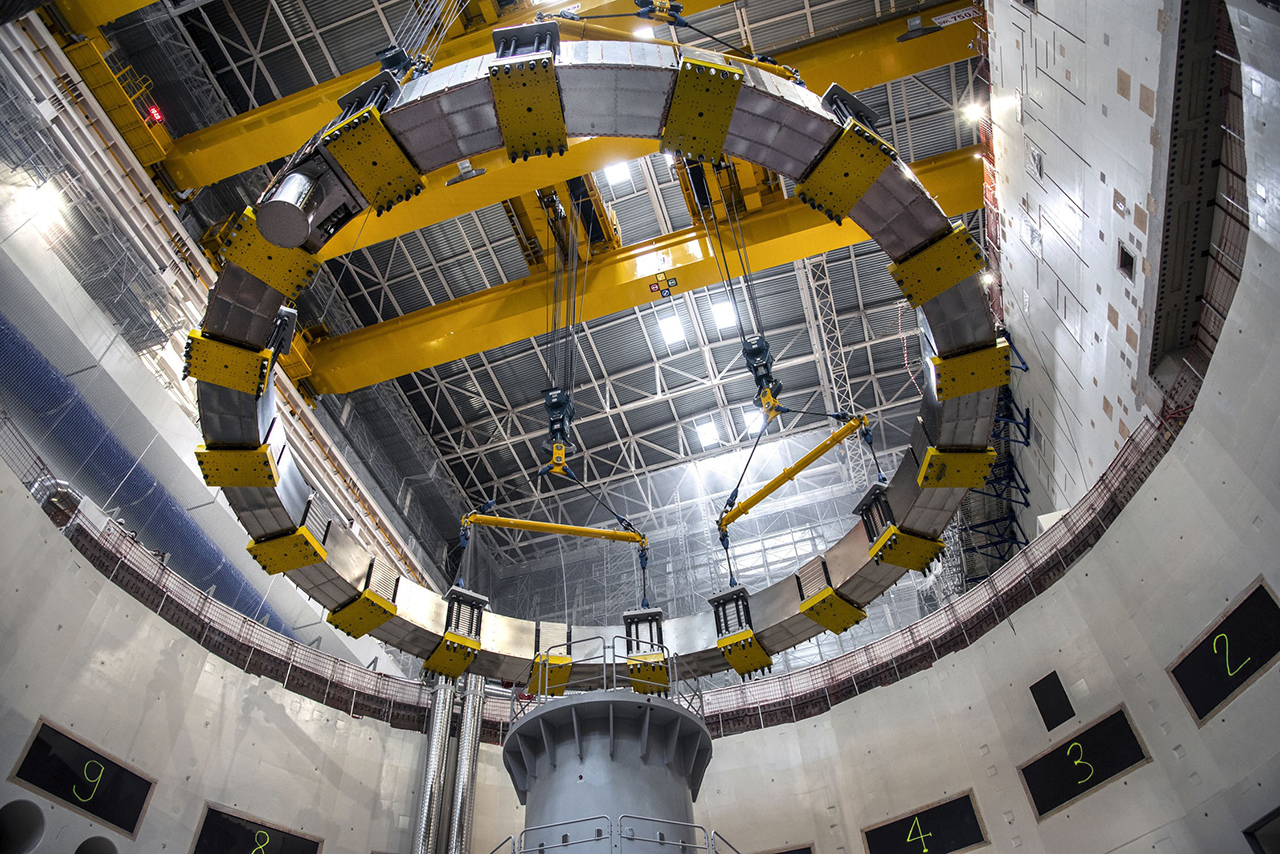
A poloidal field coil is lowered into the ITER Tokamak Pit.
As the largest tokamak ever built, ITER will set records in several areas, beginning with its size. The vacuum vessel will measure 19.4 metres across and 11.4 metres high, with an interior volume of about 1,400 m3. It will accommodate approximately 840 m3 of plasma, far more than any previous tokamak. The vessel itself will weigh about 5,200 tonnes.
Temperature
ITER plasma is expected to reach temperatures of around 150 million kelvin, about ten times hotter than the core of the Sun and sufficient for efficient deuterium-tritium fusion.
Vacuum
The vacuum vessel is surrounded by a cryostat with a volume of about 16,000 m3, the largest stainless-steel high-vacuum pressure chamber ever built. Within this enclosure, plasma at around 150 million kelvin will be separated by only a few metres from superconducting magnets operating at about 4 K.
Magnetic Coils
About 100,000 kilometres of Nb3Sn superconducting strand were manufactured for ITER’s toroidal field magnets. Each of the 18 toroidal field coils is about 17 metres high and weighs roughly 310 tonnes. The six poloidal field coils are even larger in diameter; the largest is about 24 metres across and the heaviest weighs around 400 tonnes. Several of the largest poloidal coils had to be manufactured directly on the ITER site because they were too large for conventional transport. The strongest magnetic field in the machine will be generated by the central solenoid. At a maximum field of about 13 T, the central solenoid will experience electromagnetic forces of up to about 60 MN — roughly twice the thrust of a Space Shuttle at lift-off.
First Wall
Plasma-facing components will experience some of the most severe thermal loads in the ITER machine. The tungsten-armoured first wall must withstand intense heat and neutron fluxes, while the divertor targets will face the highest local heat loads, reaching around 10 MW/m2 or more in the most heavily loaded areas.
Fusion
ITER is designed to produce 500 MW of fusion power from 50 MW of external plasma-heating power, corresponding to a plasma gain factor of Q ≥ 10. No magnetic-confinement experiment has yet reached Q = 1; JET achieved the highest tokamak value, about Q = 0.67. In inertial confinement, the National Ignition Facility has exceeded unity target gain: in April 2025 it produced 8.6 MJ of fusion energy from 2.08 MJ of laser energy delivered to the target, corresponding to a target gain of 4.13. These gain figures are defined differently and should not be directly equated.
Weight
The ITER machine will weigh about 23,000 tonnes — roughly as much as three Eiffel Towers.
Budget
ITER is one of the most ambitious and technically demanding international science and engineering projects ever undertaken. Its total cost is difficult to express as a single figure because much of the project is funded through in-kind contributions from the seven ITER Members, and the budget has evolved as the design and schedule have been revised.
Online 3D Model
Free Downloads › Online 3D