








Main Principles
5 min read
Online 3D Model
Free Downloads › Online 3D
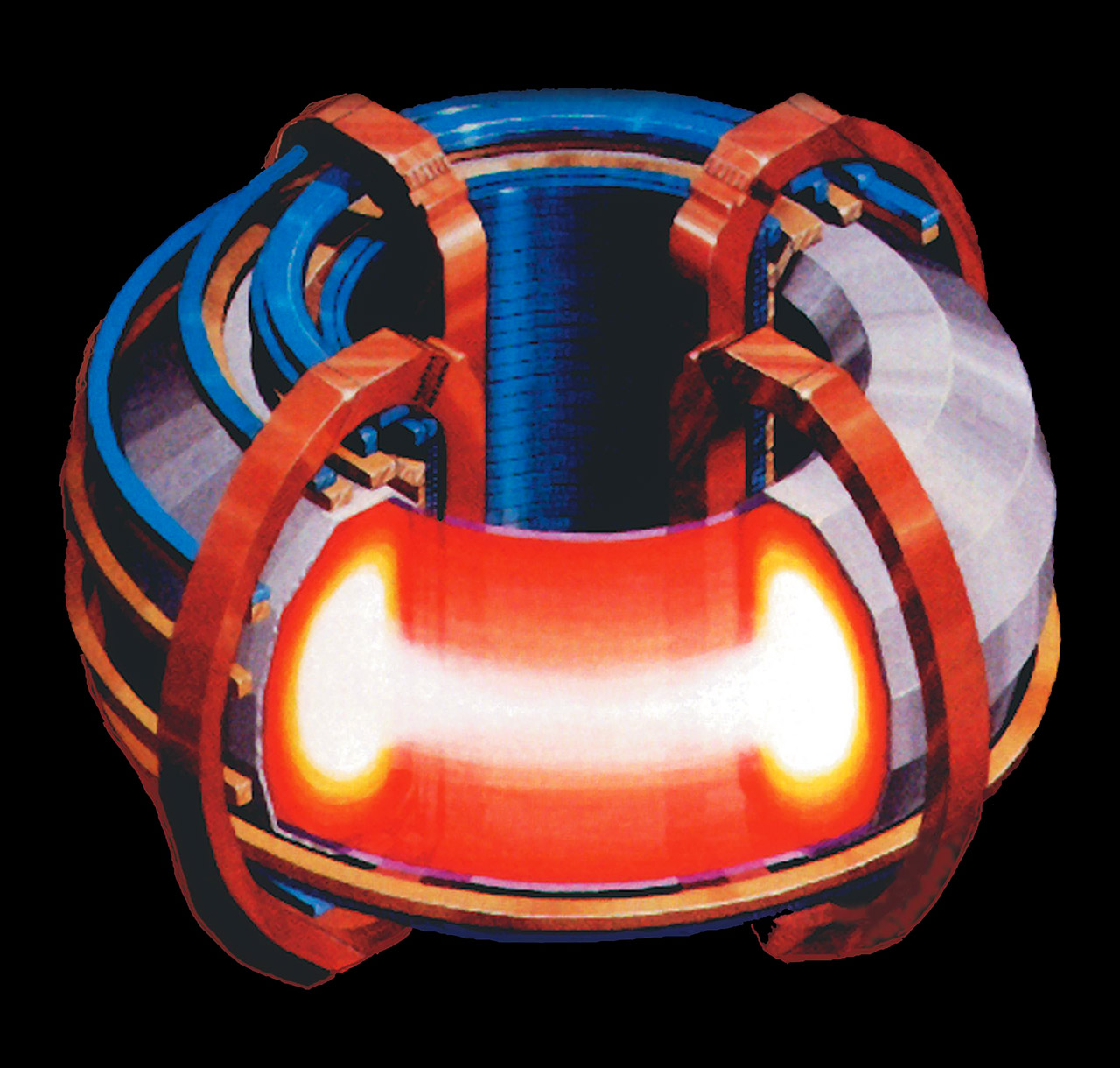
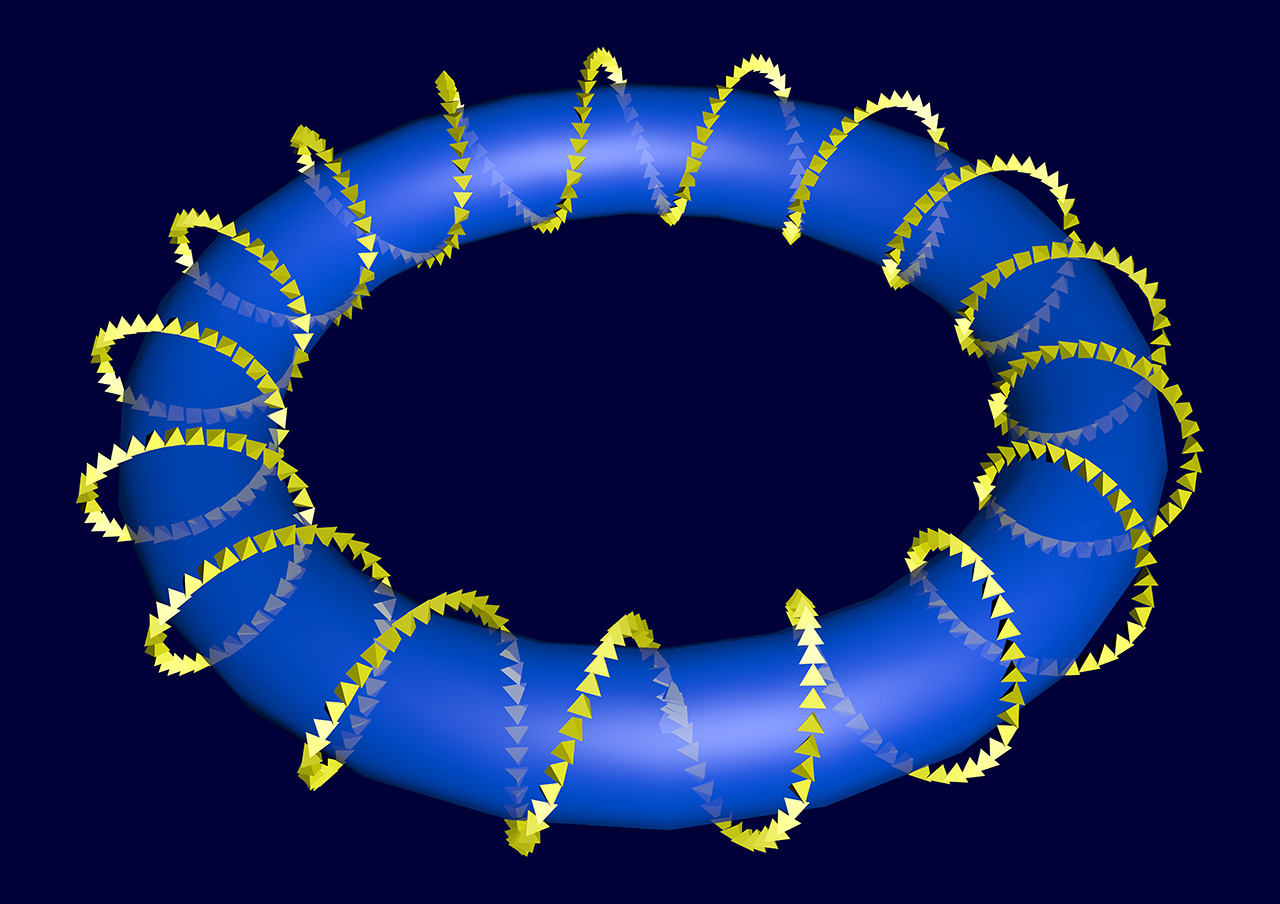
Concept of magnetic fusion confinement.
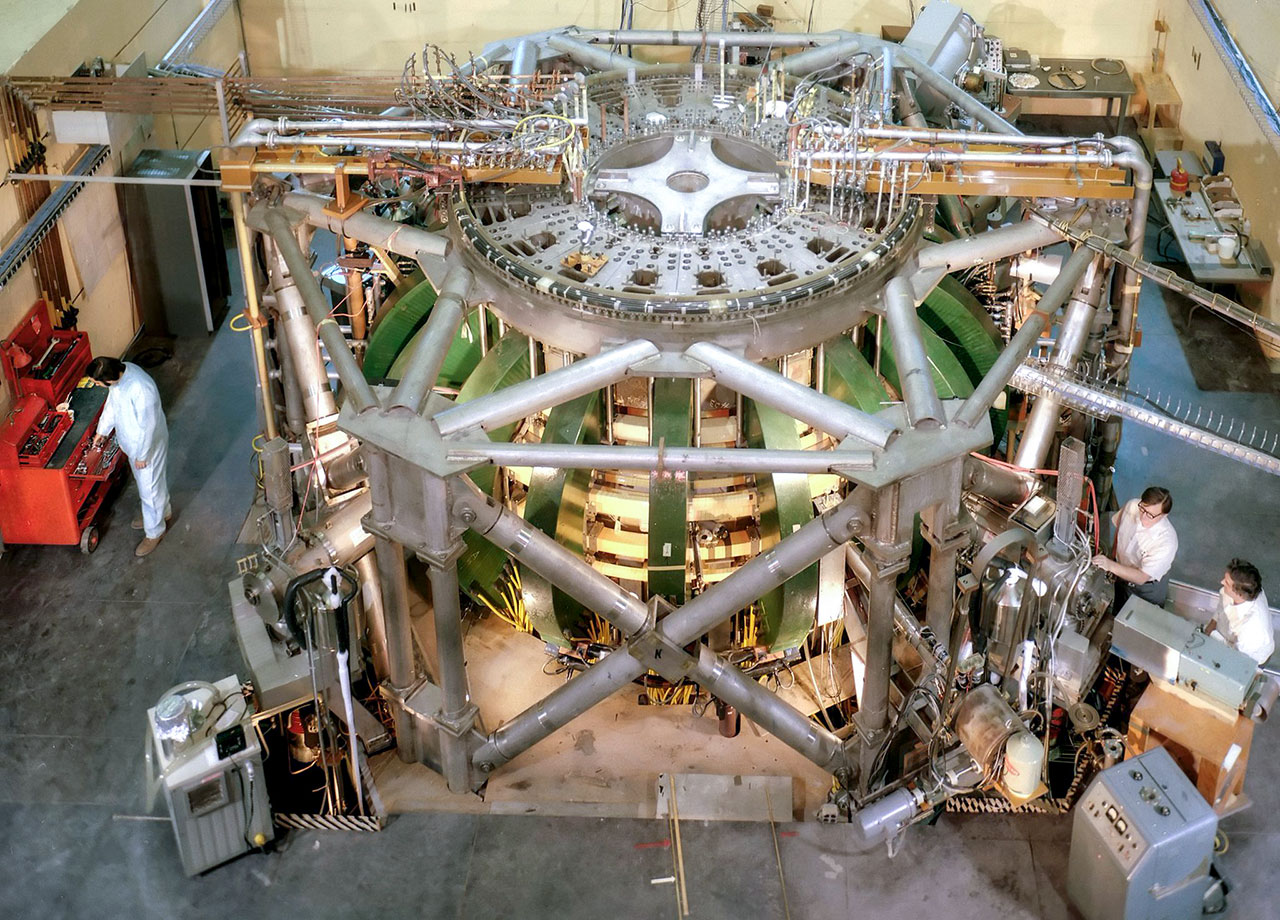
The word “tokamak” is of Russian origin and is an acronym for “TOroidalnaja KAmera i MAgnitnyje Katushki” — toroidal chamber with magnetic coils. It uses a magnetic cage in the shape of a torus, rather like a doughnut, created by magnetic coils. In this cage, hot plasma can be isolated from the vessel wall, heated to fusion temperatures of around 150 million kelvin, and ideally brought to thermonuclear ignition.
Toroidal Magnetic Cage
The magnetic cage can be used because, at sufficiently high temperatures, matter is ionised into negatively charged electrons and positively charged ions that respond to magnetic fields. Charged particles move in helical paths around magnetic field lines. Ions generally have larger Larmor radii than electrons and gyrate in the opposite direction.
In a straight magnetic field, such as that produced inside a long solenoid, charged particles spiral along the magnetic field lines and can form a column of hot plasma separated from the walls. Since an infinitely long solenoid is impractical, one possible solution is to bend the magnetic configuration into a torus. The doughnut-shaped chamber surrounded by toroidal field coils forms the basic geometry of a tokamak.
Because the toroidal field is stronger on the inner side of the torus than on the outer side, charged particles experience gradient and curvature drifts across the magnetic field. Electrons and ions drift in opposite directions, creating charge separation and an electric field that can drive the plasma outwards. A simple toroidal magnetic field alone therefore cannot provide adequate confinement.
To overcome this, the magnetic field must be twisted helically around the torus. In a tokamak, this is achieved by an electric current flowing through the plasma. The current generates a poloidal magnetic field which combines with the toroidal magnetic field to form helical field lines.
Particles are then largely confined to nested magnetic surfaces in the shape of a torus, sampling both the inner and outer sides of the device so that the unwanted drifts are largely compensated. This helps keep the plasma inside the vacuum vessel.
Plasma Current
The plasma current can be induced in much the same way as current in the secondary winding of a transformer, with the plasma itself acting as the secondary circuit. Because inductive current drive is inherently pulsed, conventional tokamak operation is also pulsed. Non-inductive current-drive methods are therefore being developed to enable longer pulses and, ultimately, steady-state operation.
A third set of magnets, the poloidal field coils, is used to shape and position the plasma and to help maintain its equilibrium and stability inside the vacuum vessel.
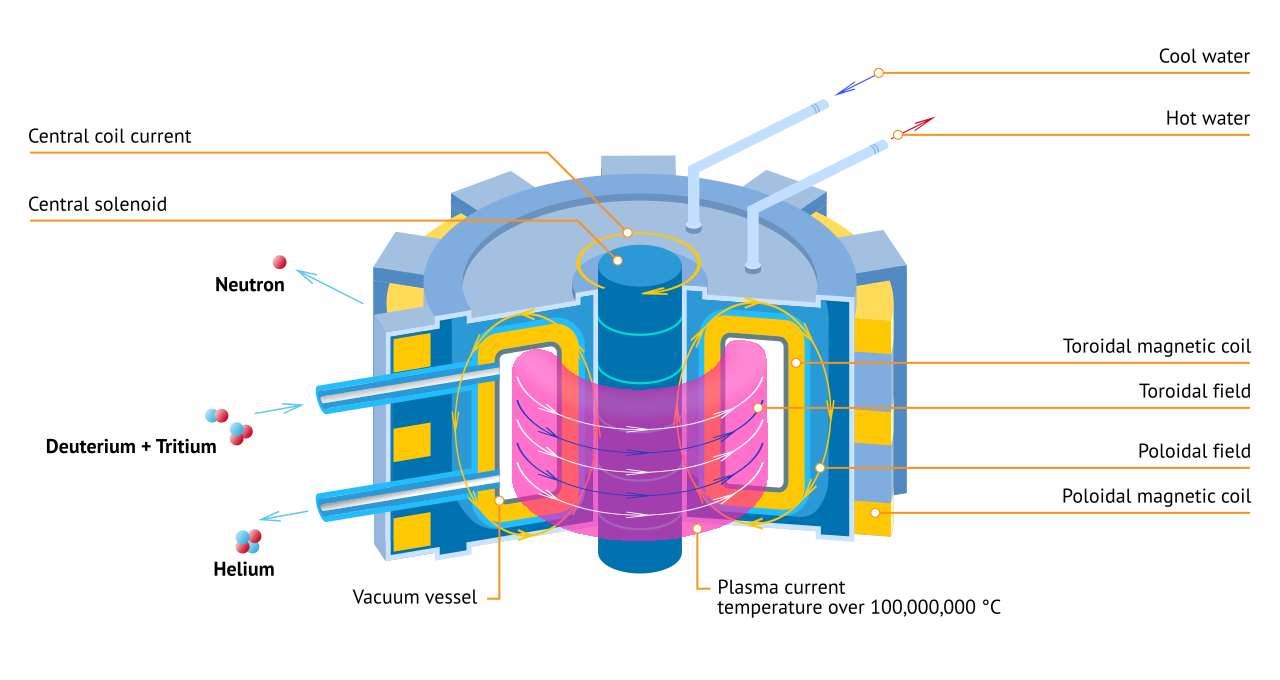
Schematic of a fusion power plant based on the tokamak principle.
Plasma Formation in Tokamak
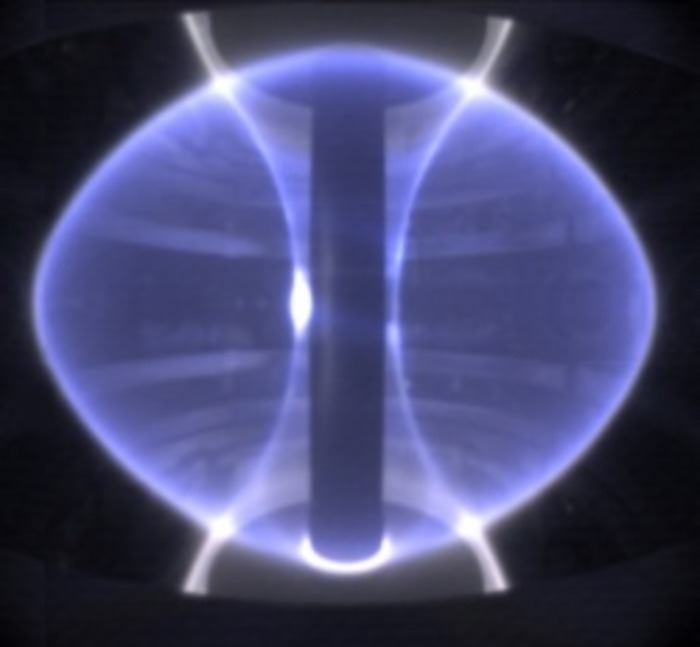
Plasma inside the MAST spherical tokamak.
To create plasma in a tokamak, the magnetic fields are first established and a small amount of working gas, usually hydrogen or one of its isotopes, is introduced into the vacuum vessel. A changing current in the central solenoid induces a toroidal electric field that accelerates free electrons. These collide with neutral atoms and ionise them, initiating a plasma discharge. The newly created charged particles are confined by the magnetic field and participate in further ionising collisions, rapidly increasing the degree of ionisation.
Heating
During the early phase of the discharge, the induced plasma current produces Joule, or ohmic, heating. As the plasma temperature rises, the gas becomes fully ionised and the electrical resistivity of the plasma decreases. Above temperatures of roughly ten million kelvin, ohmic heating becomes increasingly ineffective, so additional heating methods are required.
NBI (Neutral Beam Injection) accelerates ions to high energy, neutralises them, and injects the resulting neutral atoms into the plasma, where they are re-ionised and transfer their energy to plasma particles. Radio-frequency electromagnetic waves are also used for heating, notably electron cyclotron resonance heating (ECRH) and ion cyclotron resonance heating (ICRH).
With these heating methods combined, tokamak plasmas can reach temperatures of more than 100 million kelvin; D–T fusion experiments typically aim for around 150 million kelvin.
Pulse Regime
Inductive plasma current can be sustained only while the magnetic flux generated by the central solenoid is changing. Since this available flux swing is limited, purely inductive tokamak operation is inherently pulsed. Additional current-drive methods are therefore needed for very long pulses or steady-state operation.
One possibility is external non-inductive current drive, using radio-frequency waves or neutral beams to transfer momentum to plasma particles and sustain part of the plasma current.
Another contribution is the bootstrap current, a self-generated plasma current driven by pressure gradients and particle transport in the toroidal magnetic geometry.
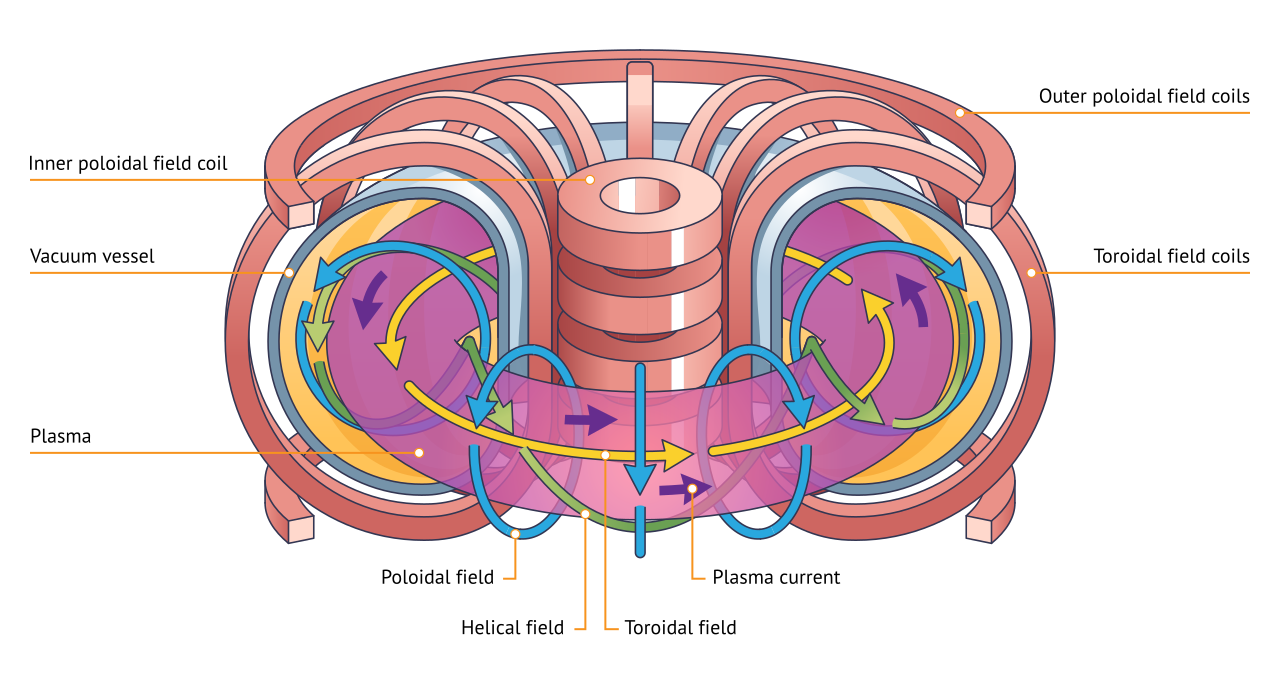
Tokamak principle.
2 pictures
2 pictures