








Main Principles
5 min read
Online 3D Model
Free Downloads › Online 3D
Deuterium–tritium fusion requires plasma temperatures exceeding 100 million kelvin, so the hot plasma must be confined without direct contact with material walls. Magnetic fields provide one way of achieving this. Plasma consists of electrons and ions which, as charged particles, respond to magnetic fields. In a magnetic field, charged particles move in helical paths around the magnetic field lines.
Ions generally have larger Larmor radii than electrons and gyrate in the opposite direction. In a straight magnetic field, charged particles spiral around the field lines while moving along them, forming a column of hot plasma separated from the walls. Such a field exists inside a solenoid, but any finite solenoid has open ends through which particles can escape.
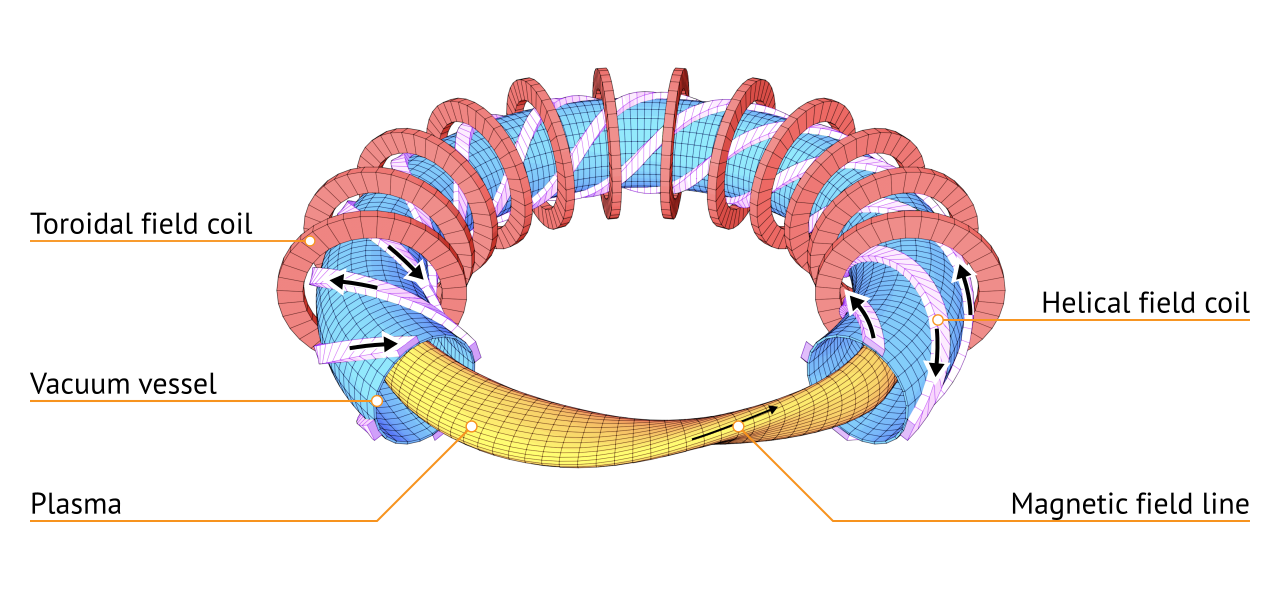
Schematic of a classical stellarator.
Free Downloads › Images
One solution is to bend the solenoid into a torus, or doughnut shape, so that the magnetic field lines form closed paths. For geometrical reasons, the coils are closer together on the inner side of the torus, so the magnetic field is stronger there than on the outer side.
Because the magnetic field is stronger on the inner side of the torus than on the outer side, charged particles experience gradient and curvature drifts across the magnetic field. Electrons and ions drift in opposite directions, causing charge separation and additional cross-field motion that would lead to particle losses. To compensate for these drifts, the magnetic field lines must be twisted helically around the torus. As a particle follows the helically twisted magnetic field, it repeatedly passes through the inner and outer regions of the torus, so the opposing drifts are largely compensated. This rotational transform helps keep the plasma confined inside nested magnetic surfaces.
Stellarator Types
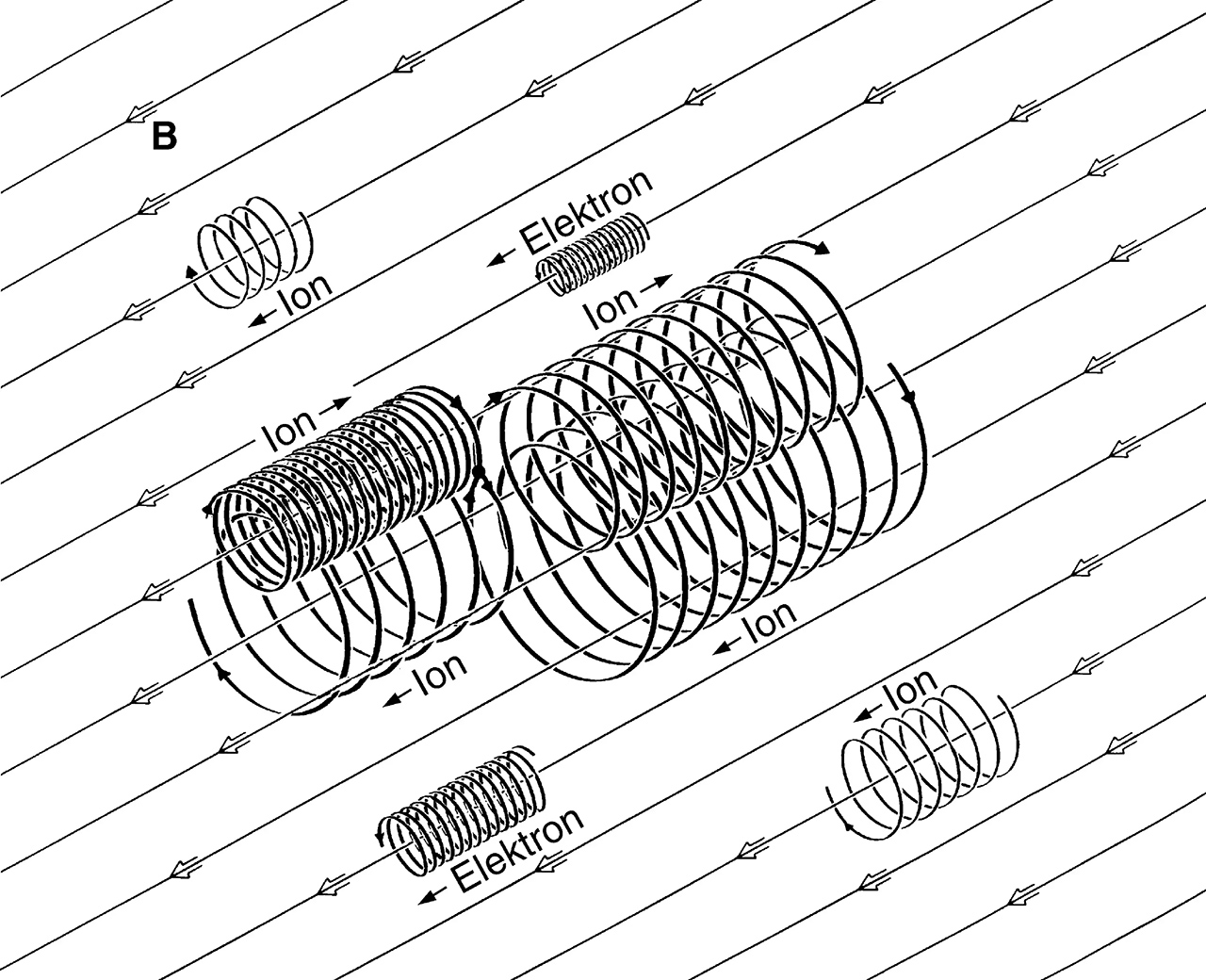
Electrons and ions in a magnetic field.
The required rotational transform can be visualised as a particle path resembling a three-dimensional figure eight. This idea led to Lyman Spitzer’s first stellarator, Model A, built in 1953. It consisted of a borosilicate-glass tube bent into a figure-eight shape and surrounded by magnetic coils. Because the two straight sections could not occupy the same plane, the end sections were tilted, producing the characteristic three-dimensional geometry of the figure-eight stellarator.
A simpler “racetrack” configuration evolved from the figure-eight concept. It used an approximately oval toroidal chamber surrounded by toroidal field coils and additional helical, or corkscrew, windings that produced the required rotational transform. Classical stellarators developed from this arrangement, using helical windings around the torus with adjacent conductors carrying currents in opposite directions.
A torsatron creates its magnetic field using one or more continuous helical coils wound around the torus, supplemented by poloidal field coils. The heliotron is closely related to the torsatron concept. A heliac uses an off-axis magnetic axis and additional coil systems to produce a strongly twisted magnetic field, often with a bean-shaped plasma cross-section. Advances in plasma theory, numerical optimisation and computing made it possible to design complex non-planar modular coils that generate carefully optimised three-dimensional magnetic fields and plasma shapes.
Modern modular stellarators use individually shaped non-planar coils to generate optimised magnetic configurations. One important family of such designs is the Helias concept, used for Wendelstein 7-X and developed to provide improved plasma confinement.
Plasma Formation
In a stellarator, the confining magnetic field is established first by the external coil system. A working gas, usually hydrogen or one of its isotopes, is then introduced into the vacuum vessel and ionised by external heating systems, often using high-frequency electromagnetic waves. Electrons absorb energy from the waves and transfer part of it to ions through collisions, producing and heating the plasma.
Another important heating method is neutral beam injection, in which energetic neutral particles are injected into the plasma and transfer their kinetic energy through collisions. Because the confining magnetic field is generated entirely by external coils and does not require a transformer-driven plasma current, a stellarator can in principle operate continuously, provided that heating, fuelling and heat-removal systems can also operate continuously.